Lab and Facilities
Our Lab

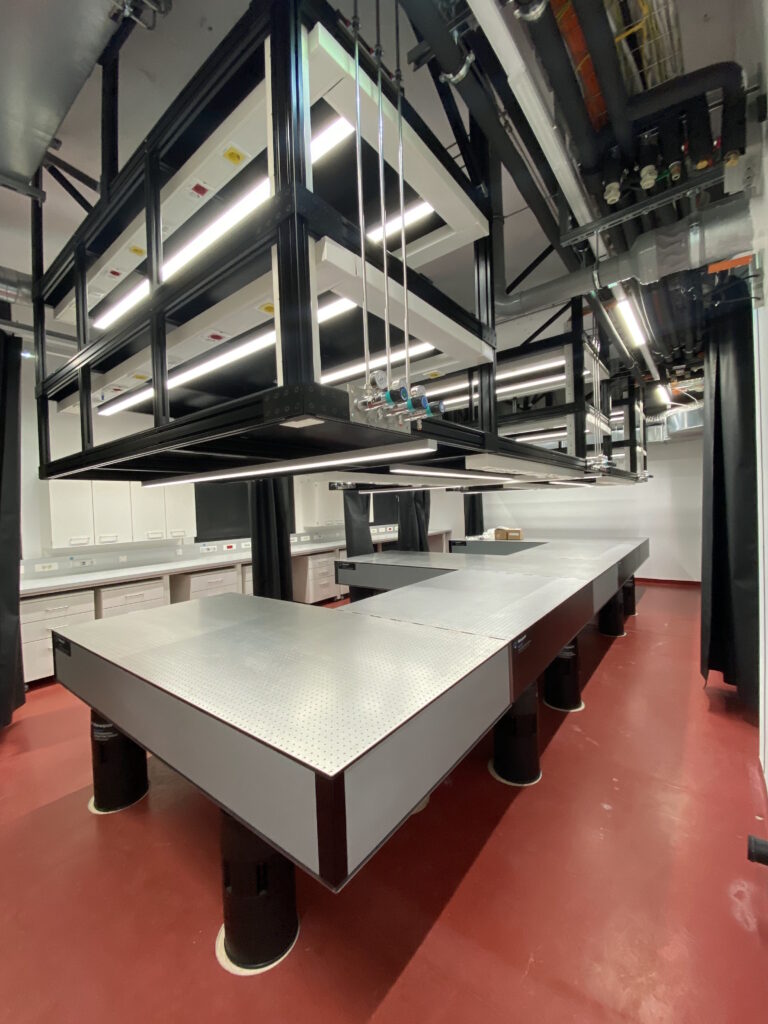


In Lab building West at ISTA we will develop a new laboratory for optical investigations of symmetry. We will combine sensitive polarimetry with low temperatures, temporal and spatial resolution, uniaxial strain, vector magnetic fields and electrical contacts. Our lab will be very flexible, allowing us the freedom to choose among a broad range of research themes, and to adapt our approach to new discoveries.
Instruments
Optical tables
Five Newport optical tables have been installed in our laboratory. These tables will be used to develop optical setups combining a femtosecond laser, optical parametric amplifiers, and a cryostat for optical probing of magnetic materials. The smaller tables (arranged horizontally) are magnetic, while the larger ones (arranged vertically) are non-magnetic.
Cryostat
The cryostat has been commissioned in our laboratory. It consists of three units: the main unit, the supporting unit, and the gas-handling unit. The magnet and sample are housed in the main unit of the cryostat. The temperature inside the main unit can be reduced to 1.6 K. Helium gas is used as the cooling agent for the superconducting coil. The system can generate a magnetic field of up to 9 T along the Z-axis and 3 T along the Y-axis.
Laser
The 40 W femtosecond laser system from Light Conversion has been successfully installed in our laboratory. Operating at a central wavelength of 1030 nm, the system drives two optical parametric amplifiers. The laser delivers pulse energies up to 133 µJ at a maximum repetition rate of 300 kHz.
Optical parametric amplifiers
Our laboratory is equipped with two optical parametric amplifiers (OPAs) from Light Conversion, offering tunable output wavelengths spanning 315–2600 nm. Each OPA is pumped by the 1030 nm fundamental output of a 20 W Carbide laser.
Facilities
Internal
We are fortunate to be in the same building as ISTA’s state-of-the-art nanofabrication facility, which we plan to make good use of! We will use optical and Raman spectrometers, the physical property measurement system (PPMS), the focused ion beam system, and others!
External
In addition to our lab and the in-house nanofabriaction facility, we will apply for time at international synchrotrons, primarily at angle resolved photoemission spectroscopy (ARPES) beamlines.